Halloween Visual Schedule for ADHD Kids | Executive Function Strategy Cards
What Happens When Your ADHD Kid's Halloween Schedule Ends Right Before the Hard Part?
You made the chart.
You printed it, taped it to the fridge, walked through it three times.
Costume at 5. Trick-or-treat at 6. Home by 8.
Then the doorbell rings too many times.
The mask feels wrong. The line at the good house is too long.
And suddenly none of that planning matters, because the chart never told you what to do when it falls apart.
You're standing on a stranger's lawn with a meltdown starting and zero tools in your hand.
Sound familiar?
Why the Usual Halloween Routine Chart Doesn't Actually Help
Everyone says "just use a visual schedule."
And a basic halloween schedule genuinely does help kids know what's coming — first this, then that, then home.
But here's the gap nobody talks about: knowing the plan and surviving the moment the plan gets hard are two completely different skills.
Most printables stop at prediction. They never touch what happens when the noise, the itch, the wait, the crowd actually hits.
So the parent is left improvising a coping strategy on the spot, in public, with an overwhelmed kid — which is exactly the moment nobody has the bandwidth to improvise anything.
And even when a hard moment is named, the child still has to say what they need, out loud, to a parent who's also stressed. For a lot of ADHD and neurodivergent kids, that's the hardest part of all — finding words while overwhelmed.
What a Genuinely Useful Halloween Support Tool Needs to Do
It has to show the whole journey, not just a few steps
Kids with executive function challenges do better when the entire sequence is visible at once — not guessed at as it goes.
It has to name the hard moments before they happen
If a chart only shows the fun parts, it leaves out the exact moments a child needs support most — the wait, the crowd, the itchy costume.
The solution has to live right next to the problem
Nobody can dig through a separate coping-skills list mid-meltdown. The answer needs to be on the same card as the struggle.
It has to travel — literally, in a pocket
A fridge chart is useless on the sidewalk. Real transition support has to fit in a small bag and move with the kid.
It has to give kids a way to communicate without needing words
When a child is overwhelmed, speech is often the first thing to go. A pointed card can say "I need a break" faster than a sentence ever could.
This Is Exactly Why the Halloween Visual Schedule for ADHD Kids Exists
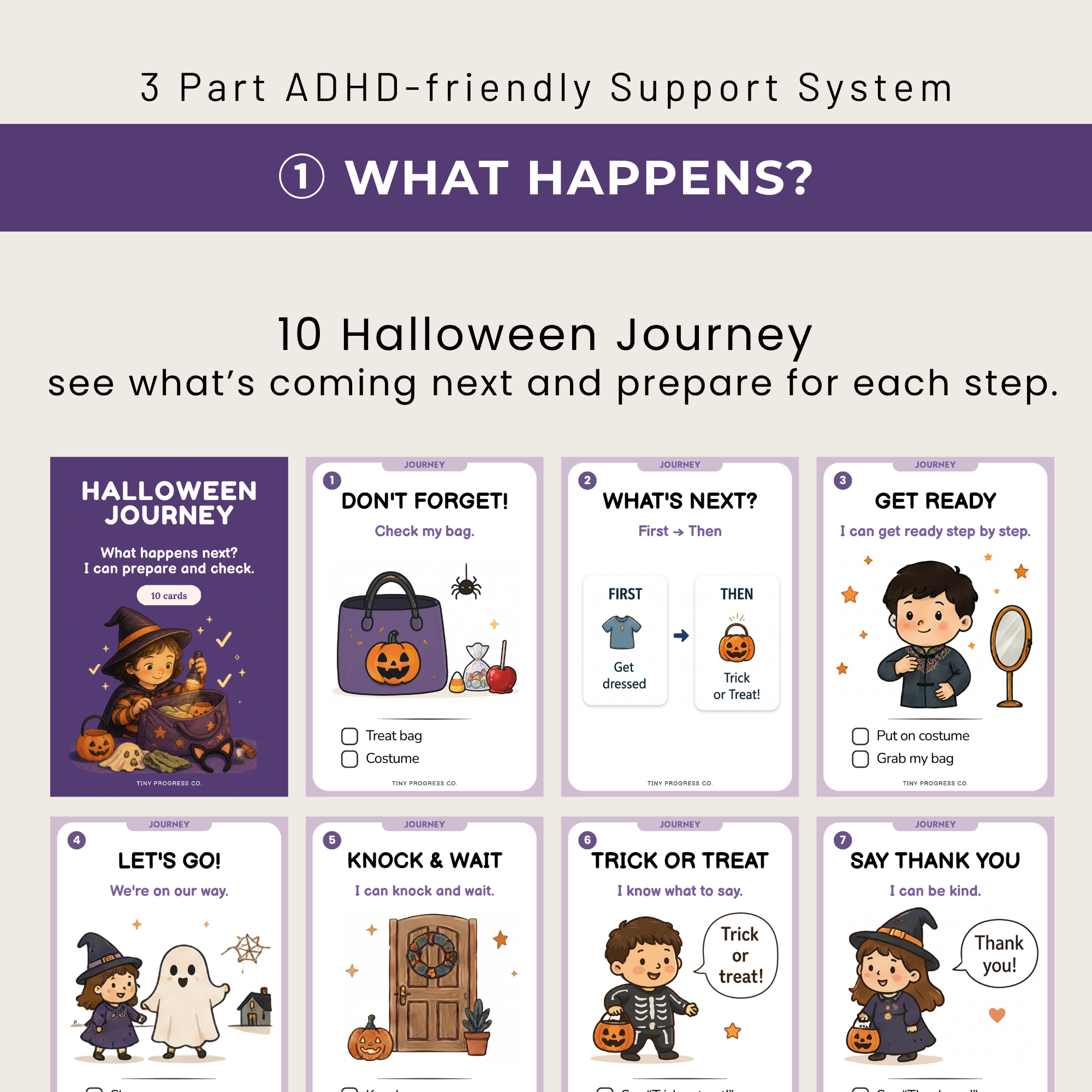
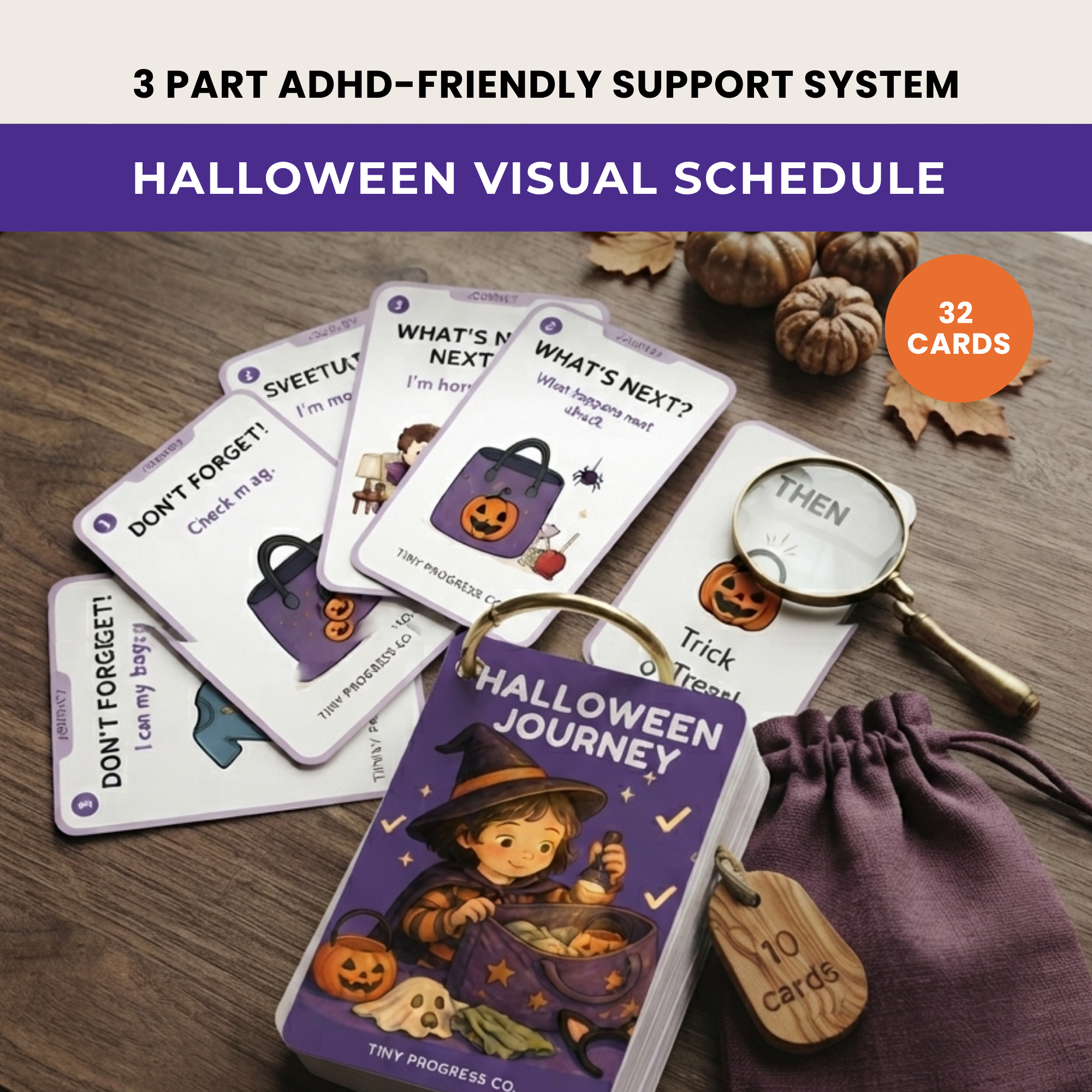
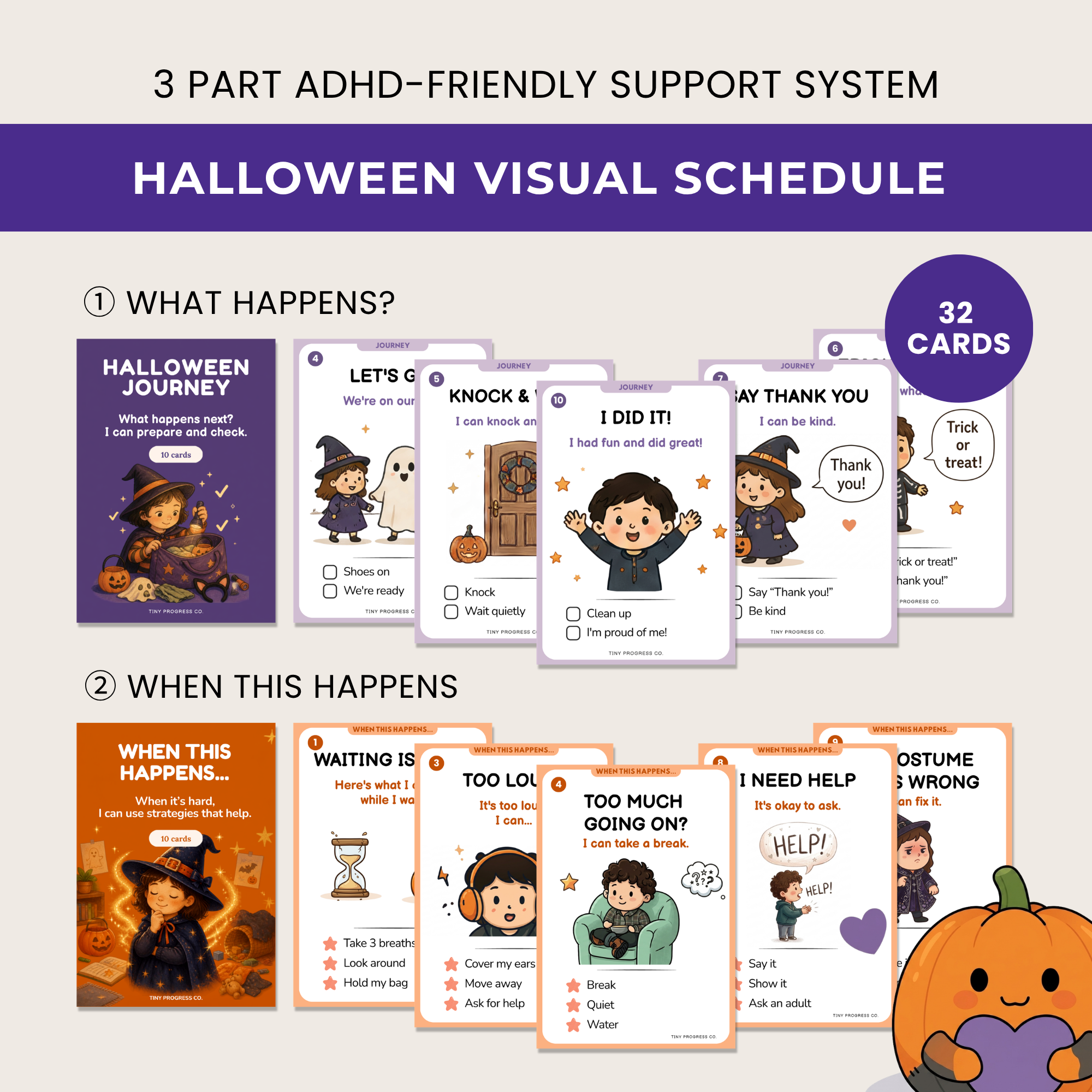
The Halloween Journey Cards show the full night, step by step
Ten cards lay out what's coming so your child can prepare instead of just react — the foundation any adhd kids printable should start with.
The When This Happens... Cards name the hard part and the fix, together
Each of the ten cards pairs a real Halloween challenge with what to do about it, right on the same card — no separate strategy sheet to remember mid-crisis.
The Mini Choice Cards go where your child goes
Eighteen small, pocket-sized cards for HELP, BREAK, QUIET, WATER, SPACE and more, so your child can point instead of trying to find words while overwhelmed — real, portable meltdown support.
Blank cards mean it flexes to your specific kid
Every child's hard moments look different. Blank cards let you add the exact situation or need that fits yours, not a generic one.
Simple design, US Letter and A4, ready in minutes
Four print-ready PDFs, uncluttered visuals so kids aren't overwhelmed by the tool meant to help them — print, cut, laminate if you want it to last, and you're set for the night.
Give the Night a Little More Room to Go Okay
You can't promise your kid a perfectly smooth Halloween. Nobody can.
But you can hand them something that says: I see the hard parts coming too, and here's what we do about them together.
That's the whole idea behind this set — prepare, recognize, respond — in a format small enough to fit in a pumpkin bucket pocket.